
Why Sri Lanka is the #1 Faculty-Led Destination of 2026
Sri Lanka was the most-booked faculty-led destination across Impact Explorers' 2025 university clients — and for a reason that bigger-name destinations cannot match: the island compresses an extraordinary range of programme types into a country small enough that a 12-day itinerary can deliver three distinct regions without losing a single day to long-haul transfers. This is a deep-dive on why Sri Lanka works so consistently for faculty-led groups, what programmes are credible there in 2026, what they cost, and where the operational gotchas sit.
Why Sri Lanka in 2026, specifically
Three factors converged this year that pushed Sri Lanka past Costa Rica into our top spot for university bookings:
- Macroeconomic recovery. Inflation has stabilised, currency exchange is friendlier for UK and US groups, and tourism infrastructure is functioning at pre-2022 levels across most regions. Per-student costs are now 20–30% lower than equivalent Costa Rica programmes.
- Programme depth. We've run programmes in Sri Lanka for 14 years through Volunteering Solutions, and added medical electives via Med Trips in 2018. That tenure means we have established partner relationships across teaching hospitals, conservation NGOs, schools and rural development programmes — not just a holding company that places students wherever there's a vacancy.
- English-medium operating environment. English is the working language in Sri Lankan hospitals, NGOs, hotels and most tourist-facing services. Programmes run smoothly without translation overhead.
Programmes that work well for faculty-led groups
Not every discipline has a strong fit in every destination. Here are the programme types we deliver in Sri Lanka most successfully — and what makes each one work specifically here.
1. Global health and public health
The strongest single programme in the country for university groups. Med Trips operates structured clinical observation rotations at major teaching hospitals in Colombo (National Hospital of Sri Lanka, Lady Ridgeway Hospital for Children, De Soysa Maternity Hospital), Kandy (Kandy Teaching Hospital), and rural Hambantota district hospitals. Faculty-led global-health Master's groups can pair urban-hospital placements with rural community-health programmes in the Central Highlands — generating a structural compare-and-contrast lens that's hard to replicate in countries with weaker secondary infrastructure.
2. Conservation biology and marine science
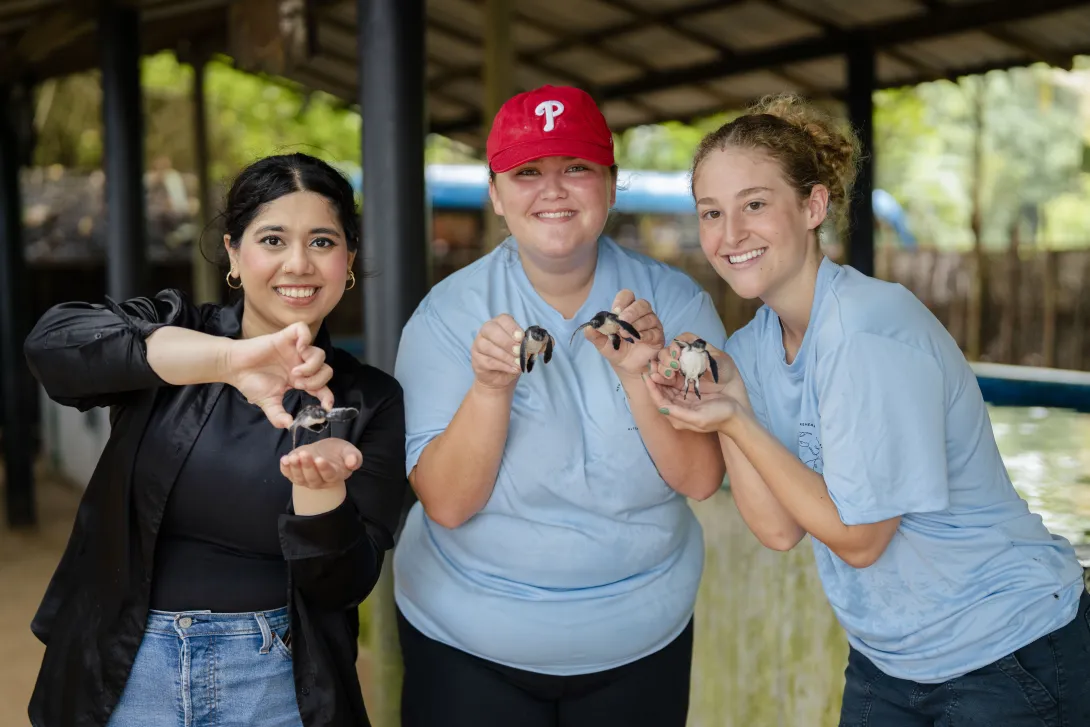
Sri Lanka's biodiversity is exceptional for its size — 26 designated National Parks, four major marine ecosystems, and three biodiversity hotspots within driving distance of each other. Programmes we run include sea turtle conservation at Rekawa and Kosgoda, elephant rehabilitation at Pinnawala and Udawalawe, leopard population studies in Yala National Park, and coral-reef restoration off the south coast. For biology and environmental-science undergraduates, the field sites accessible in two weeks here are denser than almost anywhere else.
3. Hospitality, tourism and sustainable tourism management
An underappreciated programme. Sri Lanka has a 30-year-mature tourism industry that's currently navigating a credible sustainability pivot, making it an ideal living case study for hospitality and tourism Master's groups. Programmes pair operational placements at boutique hotels with site visits to community-tourism cooperatives, sustainable-agriculture-tourism ventures, and the government tourism authority for policy briefings.
4. Education and child development
School-based programmes for education undergraduates and PGCE candidates work particularly well in tea-estate communities in the Central Highlands, where literacy-support and English-teaching programmes have ongoing volunteer placements. Groups typically combine classroom-assistant work with site visits to private and state schools for comparative perspective on educational systems.
5. Social work and community development
Women's empowerment programmes in rural Hambantota, post-tsunami community development in the southern coastal belt, and Tamil-Sinhalese reconciliation work in the eastern province all anchor substantive field experiences for social-work and development-studies cohorts.
Typical 12-day itinerary
A real itinerary we delivered for a UK Russell Group university Global Health Master's cohort in March 2025 — 18 students, lead faculty member, one programme co-ordinator from Impact Explorers travelling with the group:
- Day 1 (Mon): Arrival Bandaranaike International Airport (CMB). Transfer to volunteer accommodation in Colombo (60 min). Welcome dinner. Orientation.
- Day 2: Morning orientation at Med Trips in-country office. Afternoon site visit to National Hospital of Sri Lanka for context briefing. Evening cultural orientation walk.
- Days 3–5: Clinical observation rotations in Colombo teaching hospitals. Three students per ward, rotating across General Medicine, Paediatrics, Obstetrics. Daily 4-hour ward time + structured debrief.
- Day 6: Transfer to Kandy (3 hours). Afternoon orientation at Kandy Teaching Hospital. Cultural evening at Temple of the Tooth.
- Days 7–8: Clinical observation in Kandy + Peradeniya University Faculty of Medicine seminar.
- Day 9: Transfer to Hambantota district (3.5 hours). Evening community welcome.
- Days 10–11: Rural primary-care observation at Hambantota district hospital + community health programme visits in tea-estate villages. Direct comparison module with the urban data students gathered earlier.
- Day 12 (Fri): Group reflection session. Lunch with in-country team. Transfer to Colombo. Optional dinner. Departure.
Per-student cost for this exact itinerary in 2026: £1,395, plus international flights (~£950 from London) and £55 insurance. All-in: ~£2,400 per student.
What students actually take away
The most consistent feedback across the 12-month student survey we ran with university partners in 2025:
- "I now understand how resource-limited primary care actually works" — Sri Lanka's free-at-the-point-of-use public health system delivers measurable outcomes (life expectancy 77 years, infant mortality 6/1000) at far lower cost than richer countries. Seeing the system function is more instructive than reading about it.
- "I built clinical reasoning I couldn't have built in a classroom" — particularly in paediatrics, where local presentations of malnutrition, infectious disease and developmental conditions are different from UK or US norms.
- "The community work changed how I think about volunteer programmes" — students consistently report that seeing programmes anchored in community-defined needs (not foreign-NGO priorities) shifts their understanding of what "impact" means.
Operational realities you should know
To set expectations honestly:
- Climate and timing. The south-west monsoon (May–September) affects Colombo, the southern coast and the western hills. The north-east monsoon (December–February) affects Trincomalee and the east coast. Most programmes book January–April or July–September to optimise around these. Avoid late October and November if at all possible — that's the worst stretch for transfer reliability.
- Visa. Tourist visa (ETA) is available online and costs $50 USD for 30 days. Programmes longer than 30 days require an extension at the Department of Immigration in Colombo — straightforward but worth scheduling on a non-clinical day. Med students working in hospitals technically need a programme letter for ward access, which we provide.
- Health prep. Recommended: Hepatitis A, Typhoid, Tetanus booster, Japanese Encephalitis (if travelling outside Colombo for more than 7 days). Rabies pre-exposure prophylaxis if working with animals. Yellow Fever NOT required unless arriving from a Yellow Fever endemic country.
- Cultural and dress norms. Conservative dress is expected in clinical and rural environments — shoulders and knees covered for both men and women. Temple visits require shoes off and shoulders covered.
- Tea estate accommodation. Where programmes include time in the Central Highlands, accommodation is in either small guest houses or in our volunteer house at Karagahawatte. Both have hot water and reliable WiFi but are basic by Western standards. Faculty members should set expectations with students.
Common questions, answered
Is Sri Lanka safe for student groups in 2026?
Yes. The country has a low violent-crime rate, no active security threats relevant to programme regions, and well-functioning emergency services. UK FCDO and US State Department travel advisories are at the standard "exercise normal precautions" level. We maintain a documented safety protocol and 24/7 in-country support that has been operational since 2010 — including a successful programme evacuation during the 2022 political crisis.
How does Sri Lanka compare to India for medical programmes?
Sri Lanka tends to deliver tighter operational logistics (smaller country, easier internal transport, more consistent English in hospital wards) but India offers a wider variety of clinical case mix and a higher volume of teaching-hospital partnerships. For first-time faculty-led leaders, we usually recommend Sri Lanka. For groups returning for a second or third programme, India often becomes the next step.
What's the minimum group size for a Sri Lanka programme?
Eight paying students minimum to qualify for the free-faculty-place arrangement. Below that, individual students can join one of our open-enrolment programmes instead — see the Sri Lanka programmes page.
Can the programme include a weekend at the beach or in the cultural triangle?
Yes — most groups add a weekend in Galle or Mirissa (south coast) or Sigiriya / Polonnaruwa (cultural triangle). These are quoted as add-ons, typically £80–£180 per student depending on accommodation and inclusions.
What languages do students need?
English is sufficient for all programme activities. Picking up survival Sinhala or Tamil phrases is welcomed but never required. Pre-departure language tuition is available as an optional add-on for groups whose course content includes a language component.
The next step
If Sri Lanka is on your shortlist for a 2026 or 2027 faculty-led programme, the fastest path forward is a 30-minute scoping call to map your course objectives against specific in-country partner sites. Send a quick brief via the proposal request form and we'll respond within two business days with a tailored draft itinerary and indicative pricing.
Related reading: 15 Best Destinations for Faculty-Led Group Trips in 2026 · A Complete 2026 Guide to Faculty-Led Programmes · Sri Lanka programmes page