
Medical Electives Abroad for Med Students: What Actually Counts as Hands-On?
"Hands-on" is the single most over-used phrase in international medical-elective marketing — and the most important one to interrogate before you book. The difference between a programme where you genuinely observe ward rounds, scrub into theatre and present cases, versus one where you sit in a corridor watching from afar, is the difference between a CV-defining experience and a wasted £2,000. This article explains exactly what "hands-on" should mean in 2026 for medical, nursing, dental, midwifery, physiotherapy and pre-med students — and how to pre-screen any programme operator before you commit.
What "hands-on" should mean — clinical scope by discipline
The right scope depends on what you've already trained for. Here is what a credible international elective should offer at each career stage, based on the placement-design framework Med Trips uses across 80+ hospital partners.
Pre-med and undergraduate-medicine year 1–2
At this stage you are observing — not practising. A credible programme should give you:
- Direct ward observation of consultations, examinations and ward rounds
- Attendance at hospital teaching seminars and case presentations
- Exposure to multiple specialties (typically rotating across General Medicine, Paediatrics, Obstetrics & Gynaecology, and Surgery)
- Supervised history-taking practice with patient consent under a qualified clinician's eye
- Reflective debrief sessions with a clinical mentor
You should not be performing invasive procedures, prescribing, or making clinical decisions. Any operator that promises that level of access at this stage is either misrepresenting the placement or running an unsafe programme.
Medical students year 3–5 (clinical years)
This is where "hands-on" starts to mean something specific. A credible programme should provide:
- Structured rotations through specialties relevant to your home curriculum (typically 2–4 specialties over 4–8 weeks)
- Supervised history-taking and examination with consenting patients, written up in the format your home medical school expects
- Attendance and active participation in ward rounds, presenting your patient findings to the team
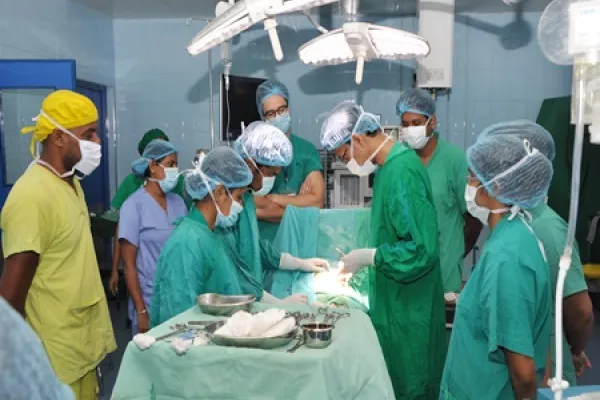
- Theatre observation, with scrub-in where appropriate, under direct consultant supervision
- Observation of procedures (lumbar puncture, central line insertion, suturing) with clear supervision boundaries
- Case-based discussion with consultants — this is the single most valuable component of a good elective
- Supervisor sign-off on a competency portfolio (required by most UK and US medical schools for elective credit)
Final-year medical students and FY1/intern-equivalent
At this stage you should be approaching the role of an active member of the clinical team, within the limits of local registration rules:
- Carrying a small caseload of patients under direct supervision
- Writing case notes that are co-signed by the supervising clinician
- Practical skills practice — venepuncture, cannulation, urinary catheterisation, suturing — when supervised
- On-call observation shifts to see how emergency care flows
- Presenting cases at departmental meetings
Nursing students
- Supervised ward placements in named wards (medical, surgical, paediatric, ICU rotation)
- Practice of nursing skills under registered-nurse supervision, including medication administration where local scope permits
- Observation of theatre nursing where the placement covers a surgical ward
- Community-health placements for groups whose curriculum includes a community-nursing component
Dental students
- Observation of clinical examinations and treatment planning
- Supervised assistance during procedures (suction, instrument passing) where local scope permits
- Direct clinical practice ONLY where the student is registered with the local dental council — most programmes therefore focus on observation + community oral-health placements
Midwifery, physiotherapy and allied-health students
Similar pattern: supervised observation, supervised assistance where local scope permits, and structured competency-based assessment.
The eight questions that separate real programmes from packaged tourism
Before booking any international medical elective, ask the operator these eight specific questions. The pattern of answers tells you whether the placement is real:
- Which specific hospital(s) and ward(s) will I be placed in? Vague answers ("a leading teaching hospital") are a red flag. Real operators name the institution.
- Who is the named clinical supervisor, and what is their specialty? Every placement should have a named senior doctor or nurse who has agreed to oversee your time.
- What is the daily schedule — what time do I arrive, what do I do in the morning, when does ward time end? A specific schedule means a real placement.
- What competencies or learning outcomes can I take back to my medical school? Programmes that can articulate this in writing have thought about the educational design.
- Can I see a sample elective report or competency form from a previous student? A real programme will share an anonymised example.
- Can I speak with three students who have done this placement in the last 12 months? A direct conversation will tell you more than a brochure.
- How is patient consent managed for student involvement? Real programmes have clear consent processes — that is a clinical-governance requirement, not optional.
- What happens if I am uncomfortable with the level of supervision or scope? A reputable operator will have an escalation route to in-country medical leadership AND to their UK/US office.
Programme length and what you can actually achieve in each
- 1–2 weeks: Sufficient for observational electives and pre-med exposure. Not long enough to develop measurable clinical competencies.
- 3–4 weeks: The sweet spot for medical student electives. Enough time to settle into a ward, build relationships with the team, and complete a structured competency portfolio.
- 6–8 weeks: Required by some medical schools (Imperial, Edinburgh, UCL) for the formal elective period. Enables deeper specialty immersion and often a small research or audit project.
- 12+ weeks: Atypical for traditional electives; more often associated with gap-year placements or pre-residency research years. Watch the visa requirements — some destinations require a different visa class beyond 12 weeks.
Destinations that genuinely deliver clinical depth
Based on placement outcomes across 1,200+ Med Trips alumni, the destinations that most consistently deliver substantive clinical exposure:
- Sri Lanka — National Hospital Colombo, Kandy Teaching Hospital, Hambantota district hospitals. Strong English-medium hospital environment, excellent for first electives.
- Tanzania (Arusha, Moshi) — Kilimanjaro Christian Medical Centre and partner district hospitals. Strong for global-health-oriented programmes.
- India (Delhi, Bangalore, Pune) — Large case volume, broad specialty range, well-established teaching-hospital traditions. Best for students wanting to see high-volume case work.
- Thailand (Bangkok, Chiang Mai) — Excellent for teaching-hospital placements at Mahidol and Chulalongkorn affiliates. Strong English in clinical environments.
- Ghana (Accra, Kumasi) — Korle Bu Teaching Hospital and Komfo Anokye partner programme. Strong for tropical medicine exposure.
- Vietnam (Hanoi, Ho Chi Minh City) — Newer to the elective circuit but strong infrastructure and excellent paediatric placements.
Red flags to walk away from
- Promises of "performing surgery" or "delivering babies" before you're qualified for that scope at home
- No named hospital or supervisor identified in your placement letter
- Programme operators who cannot produce a current medical-school accreditation letter for elective credit
- "Volunteer abroad" programmes pretending to be medical electives — these are unsupervised placements unsuitable for clinical training
- Per-student fees that include "all transport in-country" but no clear hospital-to-accommodation logistics
- No 24/7 in-country support number or no named UK / US escalation contact
- No reference letter offered at the end of the placement
- Reviews that are universally glowing — real placements have nuanced feedback because real clinical environments are imperfect
What it costs in 2026
Indicative all-in costs for a 4-week medical elective abroad (excluding international flights):
- Sri Lanka: £1,500–£2,200
- Tanzania: £1,800–£2,600
- India: £1,300–£2,000
- Thailand: £1,800–£2,500
- Ghana: £1,800–£2,500
- Vietnam: £1,500–£2,200
Add £600–£1,200 for international flights and £45–£90 for student elective insurance (separate from regular travel insurance — make sure your policy specifies elective cover). See our full faculty-led trip cost breakdown for the ancillaries.
Common questions answered
Will my medical school accept this elective for credit?
Most UK and US medical schools accept Med Trips placements for elective credit. We provide a pre-placement letter for your medical school's elective office and a post-placement competency form signed by your in-country supervisor. Always check with your elective office BEFORE booking — some schools require pre-approval of the specific hospital.
Do I need a separate insurance policy?
Yes — most standard travel-insurance policies exclude "clinical activities" or "medical electives". You need a policy that explicitly covers medical-elective activities. Medical Defence Union (UK) offers student elective indemnity; American Medical Student Association partners offer US equivalents. Budget £45–£90 for a 4-week placement.
What vaccinations do I need?
Vary by destination but typically include Hepatitis A and B (Hepatitis B is critical for any clinical placement — finish the course before departure), Typhoid, Tetanus booster, and either Rabies or Japanese Encephalitis depending on rural exposure. Yellow Fever for parts of Sub-Saharan Africa and South America. Consult a travel-medicine clinic 6–8 weeks before departure.
Can I do an elective as a nurse or as allied-health student, not as a medic?
Yes — Med Trips runs structured nursing, midwifery, dental, physiotherapy and pharmacy electives in addition to medical placements. The clinical scope adapts to your home registration and training stage.
How early should I book?
For 4-week+ placements at popular teaching hospitals, 6 months ahead is comfortable. Some destinations (Sri Lanka and Tanzania particularly) book up 9+ months in advance for the elective season (June–September coincides with most UK medical-school elective periods).
Next step
If you're planning a medical elective abroad for 2026 or 2027, send us your home institution, year of training, target dates and any specialty preferences via the Request a Proposal form or visit the Med Trips website directly. We respond within one business day with a tailored placement option.
Related reading: Why Sri Lanka is the #1 Faculty-Led Destination of 2026 · Safety & Support framework · FAQ for faculty-led, volunteer and medical programmes